


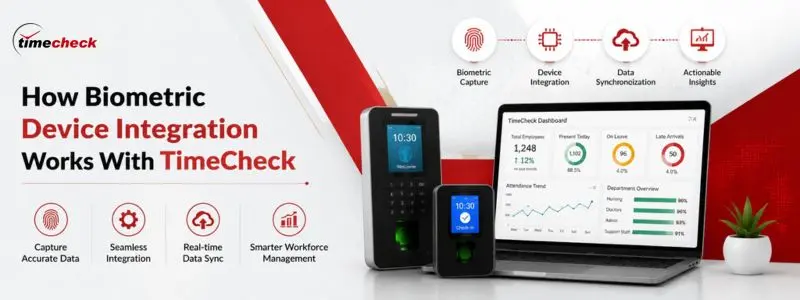
Many organizations install biometric attendance devices hoping they will immediately solve employee tracking challenges. However, a biometric machine alone can record only one type of information: employee identification data.
The actual challenge begins after the data has been collected.
HR teams still need accurate attendance records, shift calculations, overtime tracking, leave management, payroll inputs, and reports across multiple locations. Without proper biometric device integration with attendance software, organizations often continue relying on spreadsheets, making manual corrections, and managing separate systems.
TimeCheck Software connects biometric devices with workforce management software, helping organizations convert raw attendance data into meaningful workforce information.
What Does Biometric Device Integration With Attendance Software Mean?
Biometric device integration involves connecting biometric hardware, such as fingerprint scanners, face recognition devices, and RFID attendance machines, with attendance management software.
This integration allows employee attendance data captured through biometric devices to automatically transfer into a centralized software platform where HR and operations teams can manage:
- Employee attendance records
- Shift timings
- Late arrivals and early exits
- Overtime calculations
- Leave information
- Attendance reports
- Payroll-related data
In simple terms, biometric devices record attendance, while attendance software organizes, processes, and provides business insights based on that data.
For organizations with multiple branches or shift-based employees, this connection creates a reliable workforce tracking system.
Common Challenges With Standalone Biometric Devices
Many organizations assume that purchasing biometric machines is enough to achieve automated attendance. However, several operational challenges arise when the hardware operates independently.
Managing Attendance Data Remains Difficult
Although a biometric device can record when employees enter and leave, HR teams still need a system to interpret and manage that information.
For example:
A manufacturing company operating three shifts may generate hundreds of employee attendance records every day. Without connected software, HR staff may spend hours reviewing attendance records and manually calculating working hours.
Data Across Multiple Locations Creates Visibility Challenges
Organizations with branches, factories, or offices often struggle to combine attendance records from different locations.
Without centralized integration:
- Each location maintains separate records
- Managers lack real-time visibility
- HR spends more time collecting reports
- Policy enforcement becomes inconsistent
Manual Payroll Preparation Leads to Errors
Employee payments are directly affected by attendance records.
Incorrect overtime calculations, missed punches, and manual adjustments can lead to disagreements between employees and management.
Integrated attendance software helps maintain accurate attendance data that can support payroll processing.
Why Traditional Attendance Management Methods Fail
Before integrated solutions became common, many organizations depended on:
- Manual registers
- Spreadsheet-based attendance tracking
- Separate biometric machine reports
- Email-based approvals
These methods create operational limitations.
| Manual Approach | Integrated Approach |
|---|---|
| Spreadsheet attendance tracking | Centralized attendance database |
| Manual data collection from devices | Automatic biometric data synchronization |
| Human calculations for overtime | Automated overtime processing |
| Location-wise disconnected reports | Real-time workforce visibility |
| Delayed attendance analysis | Instant reporting and insights |
The issue is not the biometric device itself. The problem is the absence of a connected system that converts attendance data into useful business information.
How Modern Biometric Integration Solutions Solve These Problems
A modern biometric attendance management system combines hardware connectivity with workforce software capabilities.
Automatic Attendance Synchronization
After employees are verified using biometric devices, their attendance records can be transferred directly into the software platform.
This reduces the need for manual data entry and improves record accuracy.
Centralized Workforce Visibility
For companies with multiple branches, integrated systems provide a single view of employee attendance.
HR and operations teams can monitor:
- Branch attendance
- Shift compliance
- Employee working hours
- Attendance trends
Better Shift and Overtime Management
Shift-based organizations require more than just attendance records.
Integrated solutions help connect attendance data with:
- Shift schedules
- Working hour rules
- Overtime policies
- Employee availability
This allows operations teams to plan workforce resources more effectively.
Improved Employee Transparency
Attendance conflicts often occur because employees and managers do not have access to the same information.
A connected attendance platform creates clearer records for:
- Check-in and check-out times
- Leave status
- Overtime information
- Attendance history
This supports fair workforce management practices.
How TimeCheck Integrates Biometric Devices With Workforce Management
TimeCheck enables organizations to connect their biometric attendance devices with a complete attendance management platform.
The solution is designed for companies managing distributed teams, multiple locations, and shift-based operations.
With TimeCheck, businesses can manage:
- Biometric attendance data
- Employee attendance monitoring
- Shift management
- Leave workflows
- Overtime tracking
- Attendance reporting
Rather than treating biometric devices as independent machines, TimeCheck helps companies use attendance data as part of their wider workforce management process.
Best Practices for Implementing Biometric Attendance Integration
Select Compatible Hardware
Before implementation, ensure that biometric devices meet the required integration needs.
Consider:
- Device compatibility
- Data transfer methods
- Network availability
- Location requirements
Define Attendance Rules Before Setup
Technology cannot solve unclear attendance policies.
Organizations should define:
- Shift timings
- Grace periods
- Overtime rules
- Leave approval workflows
Clear policies help ensure that attendance data is processed accurately after integration.
Plan for Multiple Locations
For companies operating across different locations, the system architecture should be planned before deployment.
Consider:
- Central reporting requirements
- Branch connectivity
- Data access permissions
A well-planned setup helps maintain consistent attendance management across all locations.
Provide Training for HR Teams and Employees
Successful adoption depends on users understanding:
- How attendance is recorded
- How corrections are handled
- Where reports are accessed
Proper training helps employees and HR teams use the system effectively.
FAQs
TimeCheck is designed to connect attendance hardware with workforce management software, helping organizations manage biometric attendance records along with shifts, leave, overtime, and reporting requirements.
Yes. A centralized attendance system can collect data from biometric devices across multiple branches, enabling organizations to monitor workforce activity through a single platform.
Integrated biometric systems provide accurate attendance records that support payroll calculations by reducing errors caused by manual attendance entry and improving overtime tracking.
Yes. Many biometric attendance devices can integrate with HR software platforms to share attendance information. This helps HR teams manage employee working hours, overtime, leave, and attendance reports more efficiently.
Biometric device integration connects fingerprint, face recognition, or RFID-based attendance devices with attendance software. It allows employee attendance data to automatically transfer into a centralized system where it can be tracked, reported, and used for workforce management.
Content ownership: TimeCheck Software Editorial Team
Subject-matter review: TimeCheck Product Management, HR Tech & Implementation Team
Last reviewed: August 2026
This article is reviewed to ensure accuracy across TimeCheck product features, attendance management workflows, workforce automation use cases, and enterprise implementation practices.
Learn more about TimeCheck’s company background and experience on the About Us page.

