


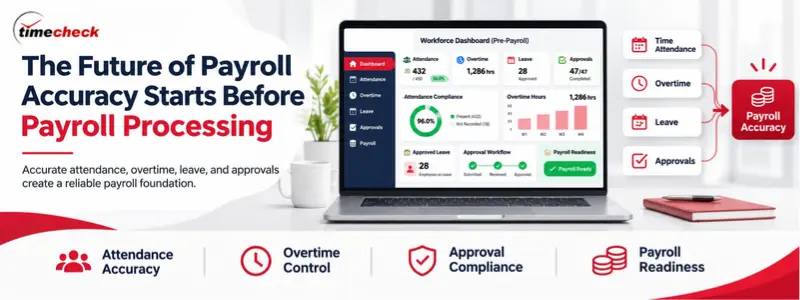
TimeCheck Software is outlining a practical approach to pre-payroll data validation for enterprises managing distributed and shift-based workforces. The analysis argues that improving payroll accuracy requires HR, Operations, and Finance to resolve attendance discrepancies, leave mismatches, overtime disputes, and approval delays before workforce records reach the payroll team.
Payroll processing is often where an error becomes visible. It is not always where the error began.
For enterprises with complex shifts, multiple locations, and large workforces, that distinction matters. A technically correct payroll calculation can still produce an incorrect result when the attendance or overtime data supplied to it is incomplete.
About the Announcement
TimeCheck’s editorial perspective focuses on an operational principle: payroll accuracy depends on the quality of the data that enters payroll processing.
Many organizations have invested in payroll automation to improve calculation speed, manage deductions, and prepare salary payments. Yet the information used for those calculations may still originate from separate attendance devices, spreadsheets, leave systems, supervisor approvals, and shift records.
A missing punch may remain unresolved. An overtime request may still be awaiting approval. An employee’s assigned shift may not match the actual schedule. A leave request may have been approved by a manager but not reflected in the attendance record.
Each issue can appear minor when viewed separately. Together, they create uncertainty about the hours, absences, and entitlements being passed to payroll.
The proposed approach is to treat the period before payroll processing as a formal validation stage, with clear ownership, defined controls, and measurable outcomes.
This shifts attention from correcting payroll errors after they occur to preventing avoidable errors before payroll inputs are finalized.
Why This Matters
Payroll accuracy affects more than administrative efficiency.
Incorrect salary calculations can lead to employee disputes, additional reconciliation work, delayed corrections, questions about overtime entitlement, and reduced confidence in workforce records.
For Finance, repeated corrections also make workforce costs harder to reconcile. For HR, they create follow-ups that could have been resolved earlier. For Operations, they may expose gaps in shift planning, overtime authorization, or supervisor accountability.
Consider an employee working an overnight shift that crosses two calendar dates.
If the shift is not mapped correctly, the attendance record may show an unexpected absence, an early exit, or an overtime discrepancy. Even if the payroll calculation follows its configured rules, the final amount may be affected by the incorrect input.
The payroll team then has to trace the record back to the employee, supervisor, shift schedule, and attendance system.
That work belongs as early as possible in the validation process.
Not every payroll error originates in workforce data. Tax treatment, employee master data, compensation changes, bank details, and other payroll-specific inputs also require controls. However, in organizations where hours worked, leave, and overtime affect pay, attendance-related information is a major part of the accuracy equation.
The business objective should therefore be broader than producing payroll quickly.
It should be to produce payroll from records that have already been checked, approved, and reconciled.
Key Highlights
- Payroll accuracy starts with reliable attendance, leave, shift, and overtime records.
- Missed punches and manual attendance corrections can create downstream payroll discrepancies.
- Approval workflows help establish who is responsible for validating payroll-impacting changes.
- Overtime should be checked against actual attendance, applicable rules, and authorization records.
- HR, Operations, and Finance need a shared definition of payroll-ready workforce data.
- Payroll cutoffs should include clear procedures for unresolved exceptions and late corrections.
- A three-cycle measurement framework can reveal which upstream issues repeatedly cause payroll rework.
- Enterprises should measure both payroll correction frequency and the effort required to resolve those corrections.
How Payroll Errors Move Downstream
An attendance discrepancy does not necessarily become a payroll error immediately.
It usually passes through several stages.
An employee may forget to record a punch. The attendance system identifies an incomplete record. A supervisor is expected to verify the actual working hours. HR may need to apply the appropriate attendance or leave rule. Payroll then receives the finalized information.
When the discrepancy is resolved at the correct stage, payroll can proceed using a verified record.
When it is not resolved, the uncertainty moves forward.
The same pattern applies to overtime.
An employee may work beyond a scheduled shift, but actual attendance hours and payable overtime are not necessarily the same. Eligibility, approval, applicable policy, and the nature of the additional work may all affect the final calculation.
If the overtime record reaches payroll without the necessary validation, the payroll team inherits a question that should have been settled earlier.
The issue is not simply a lack of automation.
It is the absence of a reliable control between workforce activity and payroll input preparation.
Five Controls That Improve Payroll Readiness
Enterprises can address this problem through five pre-payroll controls.
| Control | What Should Be Verified | Primary Responsibility |
|---|---|---|
| Attendance capture accuracy | Missing punches, duplicate entries, incorrect employee mappings, and delayed records | HR, Attendance Administration, and IT |
| Shift and rule validation | Assigned shifts, working hours, weekly offs, holidays, and relevant policy rules | HR and Operations |
| Leave and exception reconciliation | Approved leave, attendance mismatches, permissions, and manual corrections | HR and Supervisors |
| Overtime verification | Actual hours, eligibility, applicable rules, and required approvals | Operations and HR |
| Payroll-ready data sign-off | Unresolved exceptions, final reports, payroll input completeness, and changes after cutoff | HR, Payroll, and Finance |
These controls are a recommended management framework rather than a claim that every organization should use the same approval structure.
The precise ownership and validation rules will depend on workforce policies, payroll arrangements, industry requirements, and applicable laws.
The common requirement is that each payroll-impacting record has a defined route to verification.
1. Attendance Capture Accuracy
Payroll readiness starts with knowing whether attendance data is complete.
Enterprises should identify missing punches, duplicate records, delayed device synchronization, incorrect employee mappings, and other attendance discrepancies before preparing payroll inputs.
A record that appears complete in a monthly report may still contain errors if the underlying source data has not been checked.
2. Shift and Rule Validation
Attendance hours need to be interpreted against the correct shift and organizational rules.
For shift-based enterprises, errors can arise when employees move between departments, work overnight, change rosters, or follow different weekly-off arrangements.
The validation process should check whether the correct rules were applied to the relevant employee and operating period.
3. Leave and Exception Reconciliation
Leave records and attendance records must tell a consistent story.
If approved leave has not been reflected in attendance, an employee may appear absent without an explanation. If a manual attendance correction is entered after the reporting period closes, it may require a payroll adjustment.
These discrepancies should be reviewed and resolved through documented workflows before payroll inputs are finalized.
4. Overtime Verification
Overtime is particularly sensitive because it connects workforce activity with additional cost.
A useful validation process distinguishes between recorded working hours, overtime eligibility, approved overtime, and the rules applicable to the employee.
Repeated disputes may indicate unclear approval responsibilities, inconsistent records, or problems with shift and overtime rule configuration.
5. Payroll-Ready Data Sign-Off
Before information is released for payroll processing, HR and Payroll should have a shared view of its readiness.
That includes knowing which records have been approved, which exceptions remain unresolved, and how corrections submitted after the cutoff will be handled.
A formal sign-off does not guarantee that every payroll error will disappear.
It does establish accountability for the completeness and reliability of the workforce data being handed over.
The Hidden Risk of Manual Corrections
Manual corrections are sometimes unavoidable.
An employee may have a legitimate missed punch. A biometric device may fail. A shift change may be approved after the original roster was published.
The problem is not the existence of corrections.
It is the absence of consistent controls around them.
When correction requests move through emails, spreadsheets, phone calls, and informal supervisor confirmations, several risks can emerge.
A correction may be entered twice. The original reason for the correction may not be documented. The approval may be missing. Different teams may work from different versions of the same record.
As the payroll deadline approaches, the pressure to close outstanding issues increases.
That creates a difficult choice for payroll teams: hold the process while records are verified or proceed with information that may require adjustment later.
Better exception management reduces the need to make that choice repeatedly.
The aim should be to identify payroll-impacting exceptions early, assign them to the right approver, and resolve them before the final data handoff.
Why Approval Workflows Matter
Approval workflows are sometimes viewed as administrative controls.
In payroll preparation, they are also evidence of how a workforce record became final.
An overtime entry should have a clear authorization path.
A missed-punch correction should identify the requested change and the person who approved it.
A leave adjustment should be reflected consistently in the relevant records.
This gives HR and Payroll a basis for distinguishing authorized changes from unresolved discrepancies.
It also improves accountability.
When responsibility is clear, managers can address exceptions as part of their normal operational work rather than waiting for payroll teams to identify them at the end of the month.
The goal is not to introduce unnecessary approvals.
It is to ensure that the changes most likely to affect pay receive timely, documented review.
Payroll Readiness Is a Shared Responsibility
A recurring weakness in enterprise payroll preparation is the assumption that Payroll alone owns payroll accuracy.
Payroll teams are responsible for processing pay correctly. They cannot independently verify every shift change, missed punch, leave adjustment, or overtime event across the business.
Those records originate elsewhere.
Operations understands staffing requirements, actual shift activity, and the reasons for exceptional working hours.
HR manages attendance policies, employee records, leave administration, and workforce exceptions.
Payroll and Finance need complete, authorized inputs and a dependable reconciliation process.
IT supports reliable data capture, system integrations, access controls, and the availability of records.
These teams do not need identical dashboards.
They do need a shared understanding of when workforce data is ready for payroll.
A clear ownership model should answer four questions:
- Who identifies a payroll-impacting discrepancy?
- Who verifies the underlying workforce record?
- Who approves the correction?
- Who confirms that the final record is ready for payroll?
Without those answers, even an automated payroll process can become dependent on informal follow-ups.
A Three-Cycle Payroll Accuracy Assessment
Enterprises do not need a complex transformation program to understand where payroll corrections begin.
A practical starting point is to examine three consecutive payroll cycles.
The purpose is to measure the volume and source of attendance-related corrections before introducing process changes or assessing their impact.
Recommended Measures
| Measurement | What to Record |
|---|---|
| Missed-punch corrections | Number of payroll-impacting attendance records corrected because of missing or incomplete punches |
| Leave-attendance mismatches | Number of records requiring reconciliation between approved leave and attendance status |
| Overtime disputes | Number of overtime entries disputed or requiring further verification |
| Pending approvals at cutoff | Attendance, leave, or overtime records lacking required authorization |
| Shift-rule discrepancies | Records corrected because of incorrect shift or working-hour interpretation |
| Post-cutoff corrections | Payroll-impacting workforce changes received after the agreed cutoff |
| Reconciliation effort | HR, Operations, and Payroll time spent resolving workforce-data discrepancies |
| Payroll-related employee queries | Questions or disputes attributable to attendance, leave, shift, or overtime information |
The same measures should be collected for Cycle 1, Cycle 2, and Cycle 3.
Absolute counts are useful, but they should not be the only measure. A business that adds employees or expands locations may experience more corrections simply because it processes more records.
For comparability, enterprises can also track corrections per 1,000 payroll records, the percentage of exceptions resolved before the cutoff, and the time required to finalize payroll-ready attendance data.
Each correction should be classified by its primary root cause to avoid counting the same incident repeatedly.
What the Results Can Reveal
A high number of missed-punch corrections may point to attendance capture or employee-process issues.
Repeated overtime disputes may indicate approval gaps or unclear rule interpretation.
Leave-attendance mismatches may reveal delayed synchronization between HR and workforce records.
A concentration of post-cutoff corrections may indicate that the organization’s payroll-readiness deadline is not supported by timely approvals.
The most useful outcome is not a longer list of errors.
It is a clearer view of which upstream process should be improved first.
This is a proposed measurement framework. Actual reductions in correction volume, reconciliation time, or disputes should be reported only after an enterprise has collected comparable results.
What Enterprise Implementations Can Reveal
TimeCheck’s published case studies provide examples of how upstream workforce-data problems can affect payroll operations.
In a valve manufacturing case study, TimeCheck describes an organization with more than 800 employees across three plants. The organization’s original process relied on manual registers, spreadsheets, attendance-device exports, and supervisor inputs.
According to the company-published case study, the implementation was associated with a 40% reduction in payroll errors, 25% savings in overtime costs, and a 20% reduction in HR administration overhead within six months.
A separate anonymized contract workforce case study reports a 90–95% reduction in attendance-linked payroll disputes and a 60–70% reduction in manual reconciliation effort after attendance capture and approval processes were improved.
These are reported results from particular implementations, not guaranteed outcomes or industry benchmarks.
Their relevance lies in the underlying process.
Both cases describe organizations where attendance accuracy, overtime information, approvals, and reconciliation affected payroll reliability.
The management lesson is that reducing payroll rework can require changes to workforce-data preparation, not just changes to payroll processing.
Expert Perspective
The future of payroll accuracy should not be measured only by how quickly an organization calculates and releases salaries.
It should also be measured by how reliably attendance, leave, overtime, and shift information move through the organization before payroll begins.
When payroll teams repeatedly correct missing attendance records or chase approvals, they are resolving problems created earlier in the workforce process.
A more disciplined approach gives supervisors responsibility for operational verification, HR responsibility for attendance and leave reconciliation, and Payroll and Finance responsibility for final input review.
This does not remove the need for payroll controls.
It makes those controls more effective by reducing the number of unresolved questions arriving at the final stage.
For enterprises, the management objective is straightforward: payroll teams should receive verified workforce inputs rather than inherit unresolved attendance problems.
About TimeCheck Software
TimeCheck Software provides enterprise time and attendance management solutions for organizations with complex workforce operations.
Its platform supports employee attendance capture, leave and permission management, shift and roster planning, overtime management, attendance discrepancy resolution, biometric device integration, dashboards, reporting, approval workflows, and payroll-ready workforce data.
TimeCheck serves organizations across manufacturing, healthcare, logistics, IT/ITES, education, and other sectors with distributed or shift-based workforces.
The company is based in Coimbatore, India, and lists locations in India and international markets.
TimeCheck’s Software Overview and How It Works pages describe a structured attendance workflow connecting employee punching, validation, supervisor approvals, exception management, and payroll-ready reporting.
For enterprises seeking greater control over attendance-related payroll inputs, the objective is to prepare more reliable workforce data before it enters the payroll process.
Explore TimeCheck’s Product Demo to understand its attendance validation, approval, overtime, and reporting workflows.
FAQs
Enterprises can track attendance-linked corrections, missed-punch resolutions, pending approvals, overtime disputes, post-cutoff adjustments, and reconciliation hours over three payroll cycles. They should compare both absolute counts and rates per employee or payroll record, with corrections classified by root cause. Improvements should be reported only after comparable baseline and follow-up data are available.
Payroll readiness is a shared responsibility. Operations and supervisors confirm work patterns and authorized overtime. HR validates attendance, leave, and exceptions. Payroll and Finance review input completeness and reconciliation. IT supports reliable data connections and access controls. A clear cutoff and escalation process help prevent unresolved records from moving into payroll.
Approval workflows establish who must verify exceptional attendance, leave, overtime, and shift changes before information is finalized. They make corrections traceable, help prevent unsupported inputs, and reduce repeated follow-ups between HR, Operations, and Payroll. The goal is not more approvals, but timely review of records that can affect pay.
Attendance-related payroll errors can arise from missed punches, incomplete time records, incorrect shift mapping, unapproved overtime, leave-attendance mismatches, or changes entered after the payroll cutoff. These problems may increase when teams use separate spreadsheets or manually transfer data. A defined exception-resolution process helps identify issues before pay is calculated.
Pre-payroll data validation is the review of attendance, leave, shift, overtime, and approval records before they become payroll inputs. It checks whether transactions are complete, correctly classified, supported by required approvals, and consistent with company rules. Its purpose is to prevent avoidable corrections and disputes during or after payroll processing.
Content ownership: TimeCheck Software Editorial Team
Subject-matter review: TimeCheck Product Management, HR Tech & Implementation Team
Last reviewed: October 2026
This article is reviewed to ensure accuracy across TimeCheck product capabilities, workforce planning concepts, attendance management workflows, shift operations, and enterprise implementation practices.
Learn more about TimeCheck’s company background and experience on the
About Us
page.

