

Enterprise Time & Attendance Software for Pump Manufacturing
Improve Workforce Accuracy Across Production Floors, Shifts and Manufacturing Operations
Pump manufacturing organizations manage multiple departments, shifts and workforce groups across production, assembly, quality, maintenance and administration. When attendance is handled through disconnected devices, spreadsheets or manual records, it becomes harder to maintain accurate workforce data, control overtime and prepare reliable payroll inputs.
TimeCheck helps pump manufacturers centralize attendance, manage shifts, leave and overtime, improve workforce visibility and create structured attendance data for payroll processing.
Designed for pump manufacturers looking to:
- Replace manual attendance tracking with automated workflows
- Improve visibility across production departments and locations
- Reduce attendance-related payroll errors and administrative effort
- Manage shifts, leave, overtime and approvals through structured processes
- Improve workforce reporting and operational control
Critical Time & Attendance Challenges in Pump Manufacturing
Pump manufacturing operations depend on coordinated workforce availability across production and support teams. Manual or disconnected attendance processes can create delays, inconsistencies and limited visibility for HR and Operations teams.
Managing Attendance Across Production Departments
Different departments may follow different schedules and attendance requirements. Manual tracking can make it difficult to maintain consistent records across the plant.
Common challenges:
- Manual attendance tracking
- Limited workforce visibility
- Delayed attendance reporting
- Manual updates and reconciliation
A centralized attendance system gives HR and Operations teams a more reliable view of workforce information.
Controlling Shift Scheduling and Overtime
Manufacturing operations require structured schedules to maintain production continuity. Managing shifts, overtime and attendance exceptions manually increases administrative workload.
Common challenges:
- Difficulty managing employee shifts
- Manual overtime tracking
- Attendance approval requirements
- Inconsistent workforce rules
Configurable workflows help organizations apply attendance policies more consistently across teams.
Reducing Payroll Errors Through Accurate Attendance Data
Attendance directly affects payroll preparation. Incorrect or incomplete records can lead to additional reconciliation work, corrections and employee disputes.
Common issues include:
- Payroll input errors
- Attendance corrections
- Manual data consolidation
- Employee attendance disputes
- Delayed reporting
Pump Manufacturing Workforce Challenges at a Glance
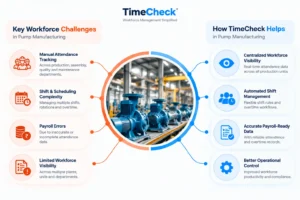
Pump manufacturers need accurate workforce information across departments, shifts and operational locations. The infographic below highlights the most common attendance, scheduling, overtime and reporting challenges that increase administrative effort and reduce operational visibility.
How TimeCheck Solves Pump Manufacturing Workforce Bottlenecks
TimeCheck helps manufacturers manage attendance, shifts, leave, overtime and reporting through centralized, configurable workforce workflows.
Centralized Attendance & Device Integration
TimeCheck supports attendance device integration, helping organizations bring workforce records into a centralized process instead of managing them separately across departments.
Key benefits:
- Centralized attendance data
- Reduced manual consolidation
- Better attendance accuracy
- Improved workforce visibility
Mobile & Geo Attendance
For employees working beyond fixed attendance points, TimeCheck supports mobile and geo attendance requirements to improve workforce visibility across distributed operational environments.
Key capabilities:
- Mobile attendance access
- Geo attendance support
- Location-based workforce visibility
- Better control over distributed teams
Shift, Leave, Overtime & Approval Workflows
TimeCheck helps pump manufacturers configure attendance workflows based on operational requirements.
Key capabilities include:
- Shift management
- Leave workflows
- Overtime handling
- Approval-based controls
- Configurable attendance rules
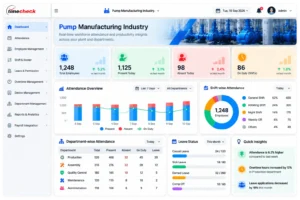
Pump Manufacturing Workforce Management Dashboard
TimeCheck dashboards help HR, Operations and Management teams monitor attendance, workforce availability, shift information and reporting insights through a centralized view.
Key Operational & Financial Benefits
Improve Payroll Readiness
Accurate attendance records reduce corrections and manual reconciliation before payroll processing.
Business outcomes:
- Improved payroll readiness
- Fewer attendance corrections
- Better overtime visibility
- Reduced administrative effort
For India-based organizations requiring payroll connectivity, TimeCheck can support customized payroll integration based on specific business and system requirements.
Improve Production Workforce Planning
Centralized attendance visibility helps HR and Operations teams understand workforce availability across production and support departments.
Business outcomes:
- Faster workforce reporting
- Better workforce planning
- Improved department-level visibility
- Reduced dependency on manual tracking
Strengthen Workforce Control
Structured attendance records, approval workflows and reports help organizations maintain better workforce transparency and operational control.
Real-World Impact: Pump Manufacturing Use Case
Pump manufacturers need workforce systems that support multiple departments and shift-based operations.
Typical TimeCheck implementation priorities include:
- Department-level workforce visibility
- Better shift and overtime management
- Improved attendance accuracy
- Faster reporting
- Reduced manual reconciliation
Customer names, workforce figures and performance metrics should only be added when supported by approved TimeCheck case study data.
Why Pump Manufacturers Choose TimeCheck
Pump manufacturers often need more than basic attendance tracking. TimeCheck combines centralized attendance, configurable workforce rules, multiple attendance channels, reporting and integration capability for complex manufacturing environments.
| Capability | Manual / Basic Approach | TimeCheck |
|---|---|---|
| Attendance | Manual tracking and corrections | Centralized attendance workflows |
| Workforce Visibility | Difficult department consolidation | Centralized department-level visibility |
| Shift Management | Manual scheduling | Configurable shift workflows |
| Overtime & Approvals | Manual calculations | Structured workflows and approvals |
| Device Integration | Separate device records | Attendance device integration |
| Reporting | Delayed manual reports | Structured workforce reporting |
System Deployment Lifecycle
1. Requirement Mapping
Map departments, shifts, attendance policies, leave, overtime and reporting requirements.
2. API & Device Synchronization
Plan required connections with HR systems, enterprise applications and attendance device environments.
3. Payroll System Alignment
Prepare structured attendance data for payroll processing. Customized payroll integration can be supported for India-based requirements where applicable.
Improve Workforce Control Across Your Manufacturing Operations
TimeCheck helps pump manufacturers reduce manual attendance administration, improve workforce data accuracy, strengthen shift and overtime control and gain better visibility across departments.
Schedule a technical discussion with a TimeCheck solution specialist to review your manufacturing workforce requirements.
FAQ
TimeCheck creates structured attendance data using attendance, shifts, leave, overtime and approval information. For India-based organizations requiring payroll connectivity, customized payroll integration can be supported based on specific system requirements.
Yes. TimeCheck supports configurable workflows for shift management, overtime, leave and approvals, helping organizations manage different workforce schedules and attendance requirements.
TimeCheck centralizes attendance information for organizations managing multiple departments, shifts and workforce groups. This reduces manual consolidation and improves workforce visibility across production and support functions.

