



Attendance Data Reveals Workforce Health
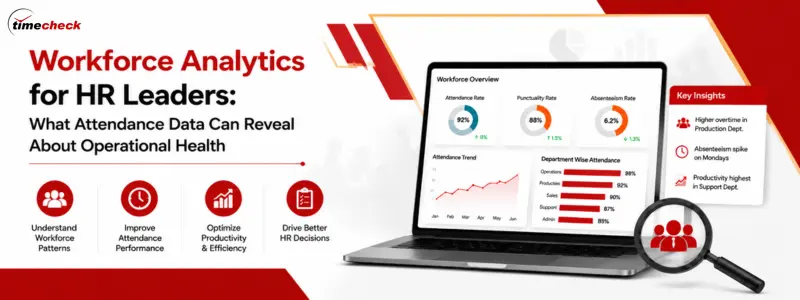
TimeCheck Software has outlined an executive perspective on how attendance data can help HR leaders understand the operational health of a workforce. The analysis focuses on how attendance patterns, exception rates, overtime dependency, late-in trends, approval delays, and payroll-ready data can reveal workforce reliability, staffing pressure, manager discipline, and process maturity across distributed and shift-based enterprises.
About the Announcement
The new perspective argues that attendance data is one of the most underused datasets in enterprise management. In many organizations, attendance records are reviewed mainly for payroll, compliance, leave tracking, and monthly reporting. But when analyzed over time, the same data can show whether a workforce is stable, whether managers are enforcing processes consistently, whether shifts are planned effectively, and whether payroll inputs are becoming cleaner or more difficult to reconcile.
This viewpoint aligns with TimeCheck’s own market context. The uploaded TimeCheck product-market fit brief identifies medium and large enterprises with distributed or shift-based workforces as a key audience, especially in IT/ITES, manufacturing, healthcare, logistics, and education. It also highlights recurring customer challenges around attendance accuracy, overtime tracking, shift adherence, payroll compliance gaps, delayed data, manual HR administration, and the need for data-driven HR decision-making.
TimeCheck’s Software Overview page describes the platform as a centralized system for managing attendance, shift-based workforce operations, leave, permissions, overtime, approvals, reports, payroll integration, and audit-ready attendance data. It also explains that TimeCheck captures, syncs, validates, processes, and reports attendance data across devices, departments, and locations.
The central point is clear: attendance reports tell HR what happened. Workforce analytics helps HR understand what those patterns mean.
Why This Matters
For HR leaders, operational health is often difficult to measure in real time. Employee engagement surveys, attrition reports, and performance reviews provide useful signals, but they are usually periodic. Attendance data is different. It is generated every working day.
That makes it one of the most practical indicators of workforce behavior.
A rising absence frequency may point to workforce fatigue, manager issues, seasonal staffing pressure, or gaps in workforce policy. A high attendance exception rate may show that attendance rules are not being followed consistently. Overtime dependency may reveal understaffing, production pressure, weak shift planning, or delayed approvals. Repeated late-in patterns may indicate transport issues, shift fatigue, location-specific challenges, or process gaps.
When HR leaders analyze these patterns properly, attendance data becomes more than a record. It becomes an early warning system.
This matters because many enterprises already collect large volumes of attendance data but do not always use it to support workforce planning, operating reviews, policy decisions, or payroll improvement. Gartner has advised HR leaders to shift people analytics from a data-driven model to a decision-centric model so analytics teams can better influence business decisions.
Deloitte’s 2025 human capital research also argues that organizations need a stronger value case for HR and workforce technology investments, one that looks beyond simple process efficiency and considers business outcomes, ways of working, human performance, and stakeholder impact.
Key Highlights
- Attendance data can reveal workforce reliability, not just employee presence.
- HR leaders should track absence frequency, attendance exception rate, overtime dependency, late-in patterns, approval delays, manual corrections, and payroll correction frequency.
- Workforce analytics can help identify staffing pressure, policy inconsistency, manager discipline issues, and process maturity gaps.
- Dashboards should serve different stakeholders differently: HR needs policy and exception visibility, Operations needs staffing and shift coverage, Finance needs payroll readiness, and leadership needs workforce health indicators.
- Clean attendance data is a foundation for predictive workforce planning and future AI-supported decision-making.
- An attendance-to-payroll analytics map can show which workforce metrics influence payroll accuracy, workforce cost, and operational planning.
- The maturity shift is from attendance reporting to workforce analytics, and then from workforce analytics to decision support.
Industry Context
The demand for workforce analytics is rising because enterprise workforces are becoming more distributed, more flexible, and more operationally complex. Many organizations now manage a mix of office employees, shift workers, branch teams, remote staff, field workers, contract employees, and hybrid teams.
In this environment, static attendance reports are not enough. HR leaders need to know which patterns are stable, which are worsening, and which require intervention.
TimeCheck’s Attendance Reports page shows the operational depth of attendance data. It includes attendance data, overtime data, late entry, early exit, defined work hours, actual worked hours, overtime hours, headcount summaries, manual time entry, punctuality reports, leave reports, overtime reports, and comp-off reports.
The next step is not simply producing more reports. It is interpreting the data in a way that supports decisions.
McKinsey’s 2025 AI research notes that organizations capturing stronger value from AI are redesigning workflows, embedding AI into business processes, tracking KPIs, strengthening governance, and investing in data and technology infrastructure. For workforce management, the practical lesson is clear: predictive planning and AI-supported workforce decisions depend on clean, structured, and trusted attendance data.
What Attendance Data Can Reveal
Workforce Reliability
Attendance patterns can show whether teams are consistently available when needed. Absence frequency, late-in trends, early exits, missed punches, and recurring exceptions can help HR identify departments or locations where workforce reliability may be weakening.
Manager Discipline
Attendance data can also reveal process discipline. Delayed approvals, frequent manual corrections, unresolved exceptions, and inconsistent overtime approvals may indicate where managers need better workflows, clearer accountability, or improved training.
Staffing Pressure
Overtime dependency is one of the clearest signals of staffing pressure. If overtime is concentrated in specific shifts, departments, or locations, HR and Operations can investigate whether the issue is demand, understaffing, poor scheduling, absenteeism, or manager-level planning gaps.
Process Maturity
A mature workforce process produces clean, timely, and payroll-ready data. A less mature process produces repeated corrections, delayed approvals, inconsistent reports, and manual reconciliation. Attendance analytics helps HR leaders see where process maturity is improving and where it remains fragile.
Payroll Readiness
Attendance data directly influences payroll quality. Leave records, overtime approvals, shift mapping, attendance exceptions, and manual corrections all affect how quickly payroll can be closed and how often payroll teams need to resolve disputes.
The Attendance-to-Payroll Analytics Map
A practical way for HR leaders to use workforce analytics is to build an attendance-to-payroll analytics map. This map connects workforce behavior to payroll accuracy and operating cost.
| Workforce Metric | What It Reveals | Business Impact |
|---|---|---|
| Absence frequency | Repeated absence patterns by employee, department, shift, or location | Staffing pressure, productivity loss, workforce planning gaps |
| Attendance exception rate | Missed punches, late entries, early exits, or irregular records | Manual correction workload, payroll delay, policy inconsistency |
| Overtime dependency | Repeated overtime across teams, shifts, or locations | Higher workforce cost, understaffing signals, shift planning gaps |
| Late-in patterns | Recurring late arrivals by team, location, or shift | Discipline issues, commute challenges, scheduling problems |
| Approval delay | Time taken to approve attendance, leave, overtime, or corrections | Payroll closure delays, manager process gaps |
| Manual correction frequency | Number of edited, adjusted, or corrected attendance records | Weak data quality, audit risk, HR workload |
| Payroll correction volume | Number of payroll-impacting attendance changes after closure | Payroll disputes, finance reconciliation effort |
| Shift adherence | Match between scheduled shift and actual attendance | Workforce allocation quality, operational continuity |
| Leave-attendance mismatch | Difference between leave records and attendance status | Policy gaps, payroll errors, employee disputes |
| Report closure time | Time taken to finalize payroll-ready attendance data | HR efficiency, payroll speed, reporting discipline |
This map gives HR leaders a structured way to move from attendance reporting to workforce analytics. It also helps align HR, Operations, Finance, and leadership around a shared view of workforce health.
About TimeCheck
TimeCheck is an enterprise-grade web and mobile-enabled time and attendance management software platform designed to automate timekeeping, reduce administrative burden, and support complex shift rules for diverse workforces. Its website highlights real-time visibility, extensive report generation, mobile access, shift management, geo attendance tracking, payroll integration, and approval workflows.
The platform supports attendance tracking, leave management, shift and roster planning, overtime tracking, mobile attendance, geo attendance, reports, dashboards, and workforce reporting for HR, Admin, IT, Operations, and Management teams that need visibility across departments, branches, shifts, and locations.
The company’s website states that TimeCheck has 300+ satisfied clients, 20+ industry verticals, 17+ years of experience, and 1,000,000 daily users.
FAQs
Attendance analytics improves payroll accuracy by identifying the workforce data issues that cause payroll corrections. These may include missed punches, delayed approvals, overtime disputes, leave-attendance mismatches, shift errors, and manual adjustments. Tracking these patterns helps HR reduce payroll disputes and improve closure speed.
HR leaders should track absence frequency, attendance exception rate, overtime dependency, late-in and early-out patterns, missed punches, approval delays, manual correction frequency, shift adherence, payroll correction volume, and report closure time. These metrics help connect workforce behavior with operating cost and payroll accuracy.
Attendance data is useful because it is generated daily and reflects actual workforce behavior. When analyzed properly, it can show reliability, absenteeism trends, overtime pressure, late-in patterns, manager approval discipline, and payroll-readiness issues across teams, departments, shifts, and locations.
Workforce analytics for HR leaders is the use of workforce data to understand patterns in attendance, absence, overtime, shift adherence, approvals, and payroll readiness. It helps HR move beyond static reports and identify operational risks, staffing pressure, policy gaps, and process maturity issues.
TimeCheck has outlined an executive perspective on how attendance data can reveal workforce health. The analysis explains how absence frequency, exception rates, overtime dependency, late-in patterns, approval delays, and payroll-ready data can help HR leaders improve workforce planning and operational decision-making.
Content ownership: TimeCheck Software Editorial Team
Subject-matter review: TimeCheck Product Management, HR Tech & Implementation Team
Last reviewed: August 2026
This article is reviewed to ensure accuracy across TimeCheck product features, attendance management workflows, workforce automation use cases, and enterprise implementation practices.
Learn more about TimeCheck’s company background and experience on the About Us page.

