



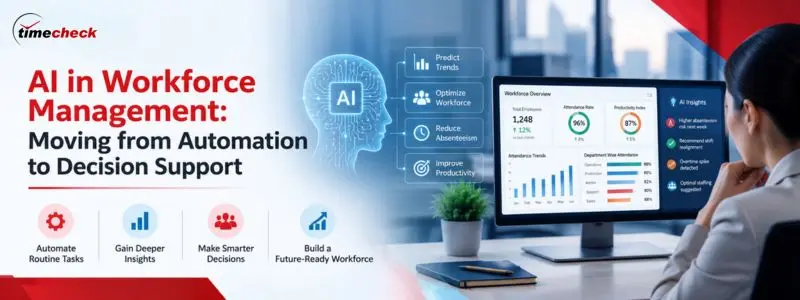
TimeCheck Software has outlined an executive perspective on the next stage of AI in workforce management: moving beyond process automation toward decision support that helps HR and Operations identify workforce exceptions, emerging risks, and recurring patterns earlier without removing human judgment from the decision.
The perspective follows TimeCheck’s August 2026 introduction of AI-powered workforce intelligence capabilities, including conversational attendance queries, AI attendance insights, missing-punch detection, real-time attendance dashboards, and AI-based workforce analysis.
The distinction matters. Automating attendance processing can reduce administrative work. AI-assisted decision support has a different purpose: helping managers understand where attention may be required and why.
About the Announcement
For years, workforce technology has focused primarily on process automation.
Attendance is captured digitally. Leave requests move through approval workflows. Shifts are scheduled. Overtime is calculated. Reports are generated. Payroll-ready data is prepared.
Those capabilities remain important.
The next challenge is what happens after the data has been collected.
An enterprise with thousands of employees may generate large volumes of attendance events, missed punches, late arrivals, overtime records, leave transactions, shift deviations, approval delays, and other workforce exceptions.
The operational problem is no longer simply collecting the data.
It is determining which information deserves attention first.
This is where AI can play a more useful role.
Instead of treating every exception as equally important, AI-assisted analysis can help identify patterns, highlight unusual activity, summarize large datasets, and direct managers toward workforce conditions that may require investigation.
TimeCheck’s August 2026 workforce intelligence update already reflects part of this transition. Its published AI capabilities include identifying attendance patterns and exceptions, analyzing absenteeism, late arrivals, and shift attendance, and allowing managers to query attendance information using natural language.
The broader opportunity is to move from workflow automation to decision support.
Why This Matters
Workforce problems rarely arrive as neatly defined alerts.
They usually emerge as patterns.
One employee working overtime may be routine.
A department accumulating overtime week after week may indicate a staffing, scheduling, workload, or approval issue.
One missed punch may be an administrative exception.
A location generating an unusually high number of attendance corrections may deserve closer review.
One absence may require no broader action.
Repeated absence patterns within a particular shift, department, or operating period may affect workforce coverage.
The value of AI is not necessarily in making the final decision about these situations.
Its value can be in finding the pattern sooner.
That distinction is particularly important for medium and large enterprises with distributed and shift-based workforces. TimeCheck’s product-market fit research identifies attendance accuracy, overtime tracking, shift adherence, manual workforce administration, delayed data, and inefficient planning as recurring challenges for this audience.
When workforce data is spread across employees, departments, shifts, branches, devices, and approval workflows, manually reviewing every record becomes increasingly difficult.
AI-assisted decision support can help narrow the field.
Managers still decide what the signal means and what action, if any, should follow.
Key Highlights
- AI in workforce management should move beyond task automation toward decision support.
- Attendance anomalies can help managers identify unusual workforce patterns that deserve review.
- Overtime concentration can be treated as a potential workforce-capacity signal rather than only a payroll calculation.
- Recurring absence patterns can support earlier investigation of staffing pressure.
- AI-generated alerts should provide enough context for managers to understand why an issue has been flagged.
- Human review should remain central when workforce insights could influence consequential employee or operational decisions.
- Reliable AI depends on accurate attendance, shift, leave, overtime, approval, and exception data.
- AI governance should address explainability, accountability, data quality, privacy, security, and harmful bias.
- AI performance should be measured by whether it improves decisions and reduces unnecessary manual review—not simply by how many processes use AI.
From Automation to Decision Support
Traditional workforce automation follows predefined rules.
If an employee works beyond a defined threshold, an overtime workflow may be triggered.
If a punch is missing, the system can record an exception.
If leave is submitted, the request can be routed to an authorized manager.
These workflows are deterministic. The organization defines the rule, and the software executes it.
AI-assisted decision support addresses a different question:
What patterns in the workforce data deserve managerial attention?
The distinction can be expressed as a simple maturity path:
Data Capture → Automation → Visibility → Analysis → Decision Support
At the automation stage, the system processes workforce transactions.
At the visibility stage, managers can see what is happening.
At the analysis stage, patterns become easier to identify.
At the decision-support stage, the system helps managers prioritize what deserves attention.
The objective is not to remove HR or Operations from the process.
It is to reduce the amount of time they spend searching for the problem.
Where AI Can Support Workforce Decisions
Attendance Anomaly Detection
Large organizations can generate thousands of attendance transactions every day.
Most records may require no intervention.
AI-assisted analysis can help surface unusual patterns for review—for example, recurring attendance exceptions, abnormal late-arrival patterns, incomplete attendance transactions, or unusual variations across departments or shifts.
TimeCheck’s published AI update already includes AI attendance insights, missing-punch detection, and analysis of absenteeism, late arrivals, and shift attendance.
The manager still needs to determine whether the pattern reflects an operational issue, a data-quality problem, an approved exception, or another legitimate circumstance.
Overtime Risk Analysis
Overtime is normally treated as a payroll and compliance measure.
It can also provide information about workforce capacity.
If overtime repeatedly accumulates within a department, location, or shift, managers may need to investigate whether the underlying cause is staffing pressure, absenteeism, scheduling, demand, approval practices, or another operational factor.
AI-assisted analysis could help prioritize these patterns for review.
This should be treated as a potential decision-support use case rather than an assertion that every overtime pattern can be interpreted automatically.
Recurring Absence Patterns
Absence data becomes more useful when HR can distinguish isolated events from recurring patterns.
AI-assisted analysis can help organize absence information by:
- department;
- shift;
- location;
- day or operating period;
- workforce category; and
- frequency.
The purpose should not be to make assumptions about why an individual is absent.
The purpose is to identify where workforce availability may require managerial attention.
Shift and Coverage Exceptions
A roster may show adequate planned staffing while actual attendance shows a different picture.
Comparing scheduled workforce levels with actual attendance can help managers identify recurring coverage gaps.
AI can support this process by highlighting unusual or repeated deviations, while Operations retains responsibility for interpreting operational context and determining the response.
Payroll Exception Prioritization
Attendance, leave, shifts, overtime, approvals, and corrections all contribute to payroll-ready workforce data.
When exceptions accumulate, HR and payroll teams may spend substantial time reviewing records manually.
AI-assisted analysis can help prioritize unusual or high-impact exceptions for human review.
The objective is not autonomous payroll decision-making.
It is more focused exception management.
A Before-AI / AI-Assisted Workforce Exception Framework
The following framework illustrates how decision support can change workforce exception management. It is a conceptual model, not a claim of measured customer performance.
| Workforce Process | Traditional Review | AI-Assisted Decision Support |
|---|---|---|
| Attendance exceptions | HR reviews exception lists manually | Unusual or recurring exceptions are prioritized for review |
| Missing punches | Records are identified and corrected individually | Patterns and repeated missing-punch issues can be highlighted |
| Absenteeism | Trends emerge through periodic reporting | Recurring patterns can be surfaced earlier |
| Overtime | OT is reviewed after hours accumulate | Concentrated or unusual OT patterns can be prioritized |
| Shift attendance | Managers compare roster and attendance manually | Repeated deviations can be highlighted for investigation |
| Multi-location review | Managers compare branch reports separately | Cross-location patterns can be summarized |
| Payroll exceptions | Teams investigate corrections during closure | Higher-impact or unusual exceptions can be prioritized |
| Management reporting | Managers interpret multiple reports | AI-assisted summaries can focus attention on significant patterns |
| Escalation | Problems are escalated after manual identification | Potential issues can be surfaced earlier for human review |
The value of this model is not simply faster reporting.
It is exception prioritization.
The Governance Question Cannot Come Later
The more AI influences workforce decisions, the more important governance becomes.
AI systems dealing with workforce data operate in an environment where decisions can affect employees, managers, payroll, staffing, compliance, and operational continuity.
That makes four governance questions particularly important.
1. Can the Signal Be Explained?
If an AI-assisted system flags a department, shift, attendance pattern, or workforce exception, managers should be able to understand what information contributed to the signal.
A warning without context is difficult to evaluate.
Explainability does not require every manager to understand the underlying model mathematics. It does require enough information to determine why an alert deserves attention.
2. Is the Underlying Data Reliable?
AI does not repair poor workforce data simply because it can analyze it faster.
Incorrect shift mappings, incomplete punches, unresolved exceptions, delayed leave approvals, inconsistent employee identifiers, or inaccurate overtime records can all affect the quality of the resulting analysis.
Before organizations ask whether their workforce system is AI-ready, they should ask whether their workforce data is decision-ready.
3. Who Is Accountable for the Decision?
An AI-generated signal is not the same as a management decision.
Organizations need clear ownership for reviewing recommendations, investigating context, documenting decisions where necessary, and determining when human escalation is required.
That distinction becomes more important as AI moves closer to consequential workforce processes.
4. Could the Analysis Produce Unfair Outcomes?
Historical workforce data can contain incomplete information, operational anomalies, or patterns shaped by past management practices.
Organizations therefore need to consider whether AI-assisted analysis could reproduce or amplify misleading patterns.
The U.S. National Institute of Standards and Technology’s AI Risk Management Framework identifies characteristics of trustworthy AI, including validity and reliability, accountability and transparency, explainability and interpretability, privacy, security and resilience, and fairness with harmful bias managed.
These principles are particularly relevant when AI-generated information could influence decisions involving employees.
Human Judgment Is a Feature, Not a Limitation
There is a tendency to measure AI maturity by how much human involvement can be removed.
Workforce management requires a different standard.
Attendance records can show that an employee arrived late.
They do not necessarily explain why.
Overtime records can show that a department consistently exceeds planned hours.
They do not automatically establish whether the cause is poor scheduling, exceptional demand, staffing shortages, approved project requirements, or another operational condition.
Absence patterns can show workforce availability changes.
They do not establish the personal circumstances behind those absences.
AI can identify correlation, variation, concentration, and unusual patterns.
Managers provide context.
For that reason, a strong workforce AI model should not be designed around the question:
How many decisions can AI make automatically?
A better question is:
How much faster can managers reach well-informed decisions because AI helped them find the relevant evidence?
Industry Context
Enterprise AI research increasingly points toward the same operating principle: value comes from integrating AI into real workflows rather than deploying AI as a separate tool.
McKinsey’s State of AI research identifies several practices associated with scaling generative AI, including embedding AI into business processes, providing role-based capability training, establishing mechanisms to build trust and capture feedback, tracking defined KPIs, and assigning governance responsibility.
That is directly relevant to workforce management.
An attendance anomaly alert has limited value if managers do not know how to review it.
An overtime-risk signal has limited value if nobody owns the response.
A workforce insight has limited value if its accuracy is never measured.
And an AI dashboard has limited value if it simply adds another screen without changing how decisions are made.
The operational challenge is therefore not simply AI adoption.
It is AI integration into accountable workforce processes.
What Enterprises Should Measure
AI initiatives should not be judged by the number of AI features deployed.
They should be judged by whether they improve the workforce-management process.
Useful operational measures could include:
- time spent reviewing attendance exceptions;
- number of exceptions requiring manual investigation;
- time between exception detection and manager review;
- repeated attendance exceptions;
- unresolved missing punches;
- overtime concentration by department or shift;
- frequency of late payroll corrections;
- accuracy of AI-generated alerts;
- false-positive rates;
- manager adoption of decision-support tools; and
- actions taken after workforce risks are identified.
These measures help distinguish an AI demonstration from an operational capability.
The Data Foundation Comes First
TimeCheck’s current platform already structures attendance information across attendance capture, validation, approvals, exceptions, reporting, shift management, leave workflows, overtime, and payroll-ready data preparation.
That structured data layer matters because AI-assisted workforce analysis depends on context.
A punch record alone says very little.
A punch record connected with the employee’s assigned shift, leave status, overtime rules, location, attendance policy, and approval workflow provides far more useful information.
The quality of workforce intelligence therefore depends partly on the quality of the workforce-management process beneath it.
AI should sit on top of structured operational data—not compensate for its absence.
Practical AI Use Cases for Shift-Heavy Enterprises
For manufacturing, healthcare, logistics, infrastructure, facilities, and other shift-intensive environments, practical AI-assisted use cases can include:
- identifying recurring attendance exceptions by shift or department;
- highlighting unusual missing-punch patterns;
- identifying shifts with repeated late-arrival patterns;
- comparing attendance behaviour across locations;
- detecting concentration of overtime for managerial review;
- surfacing recurring workforce-availability gaps;
- summarizing attendance conditions for supervisors;
- prioritizing payroll-impacting exceptions;
- answering workforce questions through conversational interfaces; and
- helping managers identify which workforce records require investigation first.
TimeCheck’s currently published AI capabilities specifically include conversational attendance queries, attendance insights, missing-punch detection, real-time attendance dashboards, and AI-based analysis of absenteeism, late arrivals, and shift attendance. Other use cases described above should be treated as strategic possibilities unless separately validated as current product capabilities.
Expert Perspective
The next phase of AI in workforce management should not be defined by how many HR decisions can be automated.
It should be defined by how effectively AI helps managers identify workforce conditions that require attention.
That means shifting the role of AI from an automated decision-maker to a structured decision-support layer.
Attendance exceptions, overtime concentration, recurring absence patterns, shift deviations, and workforce-availability gaps can generate useful signals. But those signals need context before they become decisions.
For HR, that means understanding employee and policy context.
For Operations, it means understanding workload, staffing, and service requirements.
For Finance, it means understanding workforce cost and payroll impact.
For IT, it means ensuring that data, access controls, integrations, and governance remain reliable.
The strongest enterprise model is therefore not AI instead of managers.
It is AI helping managers find the right problem earlier, with humans remaining accountable for what happens next.
About TimeCheck Software
TimeCheck Software provides enterprise time and attendance and workforce management capabilities for organizations managing complex attendance, shift, leave, overtime, reporting, and payroll-ready workforce processes.
The platform supports attendance management, leave management, shift and roster planning, overtime tracking, mobile and geo attendance, biometric integration, dashboards, reports, approval workflows, and multi-location workforce visibility.
In August 2026, TimeCheck announced AI-powered workforce intelligence capabilities, including conversational attendance queries, AI attendance insights, missing-punch detection, real-time attendance dashboards, and AI-based workforce analysis.
TimeCheck’s homepage currently reports 300+ satisfied clients, more than 20 industry verticals, and 1,000,000 daily users.
The company also operates a channel-partner and system-integrator ecosystem and describes integration relationships with biometric-device OEMs.
TimeCheck’s Recognition page states that awards, certifications, partner validations, ratings, and media recognition are published only when supporting evidence is available, reflecting a verification-first approach to public recognition claims.
FAQs
Enterprises should consider data quality, explainability, privacy, security, access controls, accountability, bias, human review, auditability, and performance monitoring. Organizations should also define who reviews AI-generated alerts, how disputed or inaccurate signals are handled, and which workforce decisions should always require human approval.
Workforce data does not always explain the context behind employee behaviour or operational events. Human oversight allows managers to evaluate AI-generated signals against policies, approved exceptions, operational requirements, and individual circumstances. It also helps organizations maintain accountability when AI insights contribute to workforce-related decisions.
AI-assisted analytics can potentially identify concentrations and recurring patterns in overtime and staffing data. These patterns can help managers decide where further investigation is needed. However, the underlying cause still requires human assessment because overtime may result from demand, staffing levels, scheduling, absence, projects, or approved operational requirements.
AI can help analyze large volumes of attendance information and highlight patterns that may require review. Examples include missing punches, recurring attendance exceptions, late-arrival patterns, absenteeism trends, and shift-attendance variations. This can reduce the amount of time managers spend manually searching reports for relevant workforce issues.
AI workforce decision support uses artificial intelligence to analyze workforce data, identify patterns, prioritize exceptions, and highlight potential risks for managers. It does not require AI to make the final workforce decision. HR and Operations teams review the information, consider operational and employee context, and determine the appropriate response.

