

TimeCheck Software has presented an executive view of how attendance data is evolving from being used merely for HR administration to serving as a layer of workforce intelligence for companies with distributed, shift-based, and multi-location teams. This analysis is directed at HR leaders, heads of operations, IT managers, finance stakeholders, and other enterprise decision-makers who want to enhance workforce visibility, ensure greater payroll accuracy, and improve operational planning.
About the Announcement
The new executive perspective argues that attendance records are not merely payroll inputs or documents needed for regulatory compliance. In companies with more than one site, rotating shifts, field teams, hybrid workers, and overtime rules, attendance data now provides indications of staffing pressure, absenteeism, productivity, approval delays, payroll risk, and operational discipline.
The way TimeCheck Software positions its platform reflects this change. The company describes TimeCheck as enterprise-grade software for web and mobile use, designed to automate timekeeping, lessen administrative workload, and handle complex shift rules for diverse workforces.
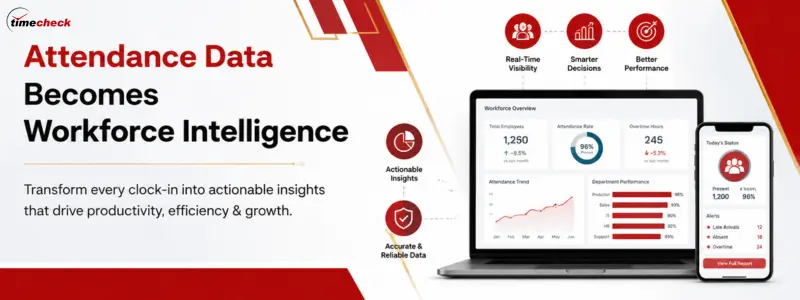
The company’s workflow content also illustrates the route attendance data takes, from punch-in capture to exception review, HR reconciliation, payroll-ready reports, and management visibility. TimeCheck states that its dashboards and reports enable managers to monitor attendance trends, absenteeism, late arrivals, early departures, overtime, discrepancies, and workforce availability.
The main point of the article is clear: companies should stop seeing attendance data as a back-office record and instead regard it as a daily operating signal.
Why This Matters
For medium and large enterprises, workforce complexity is increasing faster than many existing HR operating models can handle. Multi-location teams, contractor workforces, hybrid arrangements, 24-hour shifts, and industry-specific attendance rules all create data problems before payroll even starts.
If attendance data is fragmented, delayed, or corrected by hand, the effects extend well beyond the HR department. Operations teams may not have a clear view of staffing shortages. Finance teams could receive late or incorrect payroll data. IT teams might have to support separate devices and systems. Leadership teams may find it difficult to assess whether the available workforce matches business demand.
That is why workforce intelligence matters. It brings together attendance, leave, overtime, shift, location, and payroll data to provide a more decision-ready view.
The current market situation supports this change. Gartner has recommended that HR leaders transition people analytics from a data-driven approach to a decision-centric one, enabling analytics teams to have a greater influence on business decisions. Deloitte’s 2025 human capital research also states that organisations need to present a stronger business case for their investments in HR and workforce technology, particularly as technology evolves from pure automation towards augmentation and improved business performance.
For TimeCheck Software’s target customers, this is not just an abstract technology trend. It affects how quickly HR can close attendance, how reliably payroll can be processed, how effectively operations can manage shifts, and how confidently leadership can review workforce performance across various sites.
Key Highlights
- Attendance information is becoming a strategic indicator of workforce performance, not merely an HR record.
- Firms need HR, Operations, Finance, IT, and senior management to have a shared view.
- Workforce intelligence can reveal patterns of absenteeism, overtime pressure, shift gaps, approval delays, and payroll-readiness issues.
- Clean attendance data is a necessary precondition for workforce planning that involves the use of AI.
- Organizations that operate across multiple locations and use shifts should establish centralised data governance if they want to expand workforce analytics.
- The most valuable workforce metrics do not simply show whether people are present or absent. They also include exception frequency, overtime dependency, shift adherence, approval cycle time, and payroll correction volume.
- The next stage of the maturity curve for HR technology will progress from capture to automation, then to analytics, and finally to decision intelligence.
Industry Context
Companies are now reconsidering the role of HR technology. For a long time, many organizations have digitized their attendance and payroll processes to cut down on manual tasks. While that remains important, the next phase is more strategic: using workforce data to improve decisions.
McKinsey’s 2025 research states that companies deriving greater value from AI are not merely deploying AI tools. Instead, they are reworking workflows, integrating AI into business processes, monitoring KPIs, establishing governance structures, and investing in data and technology infrastructure.
That insight applies directly to workforce management. If the basic data is incomplete or inconsistent, AI will not be able to reliably predict absenteeism, suggest changes to staffing levels, or identify attendance anomalies. Before businesses can use AI for predictive workforce planning, they must have reliable attendance records, clearly defined shift rules, validated leave data, established overtime workflows, approval trails, and payroll-ready reporting.
TimeCheck Software’s feature structure meets a number of these basic requirements. On its product features page, attendance tracking, leave management, shift and roster planning, reports and dashboards, mobile attendance, geo attendance, overtime tracking, and workforce reporting are listed as part of the platform’s enterprise attendance management functions.
This is particularly important in sectors including manufacturing, healthcare, logistics, infrastructure, education, and IT/ITES, where workforce availability has a direct impact on continuity, customer service, production schedules, compliance, and cost control.
Expert Perspective
Suggested Quote Direction:
“Attendance data has for a long time been considered a payroll input, but this perspective is becoming too limited for companies with distributed and shift-based teams. The true value now consists in using attendance, leave, overtime, and shift data to understand workforce reliability, operational pressure, and payroll readiness before problems worsen.”
From an industry point of view, the transition to workforce intelligence is part of a wider change in enterprise technology. Systems are now expected not only to record activity, but also to aid faster decision-making. In workforce management, this means HR teams should not have to wait until after payroll has been processed to identify attendance gaps, overtime leakage, or approval bottlenecks.
It is also at this point that IT and operations leaders take on a more central role in decisions regarding HR technology. Attendance data typically passes through biometric devices, mobile apps, cloud systems, branch networks, payroll integrations, and reporting dashboards. Workforce intelligence will remain incomplete without integration and governance.
About TimeCheck
TimeCheck Software is a time and attendance management software platform suitable for businesses that need to automate attendance, leave, shift, overtime, and workforce reporting procedures. It is built for HR, Admin, IT, Operations, and Management teams that require accurate visibility into their workforce across departments, branches, shifts, and locations.
TimeCheck’s website says it has more than 300 satisfied clients across more than 20 industries, more than 19+ years of experience, and 1,000,000 users each day.
The company’s main areas of focus are attendance automation, payroll-ready reporting, workforce visibility, shift-rule management, overtime control, mobile access, multi-location attendance data, and operational reporting for enterprise teams.
FAQs
AI can provide reliable workforce insights only if the data on which it is based is accurate, well-structured, and up to date. For AI to support absence forecasting, overtime detection, staffing recommendations, or attendance anomaly alerts, companies must first have consistent attendance data, approved workflows, shift rules, and payroll-ready reporting.
Workforce intelligence improves payroll accuracy by reducing the number of manual corrections that have to be made before payroll is processed. Reliable attendance records, verified leave information, approved overtime, mapped shifts, and exception-handling procedures all help payroll teams receive more dependable inputs and reduce disputes caused by missing or delayed records.
Attendance records are one of the most commonly gathered indicators of workforce activity. If they are organised correctly, they can show whether teams are available, whether shifts are covered, whether overtime is rising, whether rules are being followed, and whether payroll data is ready. Because of this, their value extends well beyond ordinary HR administration.
Workforce intelligence involves using workforce data to aid decision-making in human resources, operations, finance, IT, and leadership. It does not just consist of keeping attendance records. It also involves detecting patterns such as absenteeism, overtime pressure, shift gaps, approval delays, payroll correction risks, and staff availability by location.
TimeCheck has given an executive view of the transition from keeping attendance records to using workforce intelligence. This view explains how data on attendance, leave, overtime, shifts, and payroll-ready information can help companies improve workforce visibility, operational planning, and decision-making.
Content ownership: TimeCheck Software Editorial Team
Subject-matter review: TimeCheck Product Management, HR Tech & Implementation Team
Last reviewed: August 2026
This article is reviewed to ensure accuracy across TimeCheck product features, attendance management workflows, workforce automation use cases, and enterprise implementation practices.
Learn more about TimeCheck’s company background and experience on the About Us page.

