


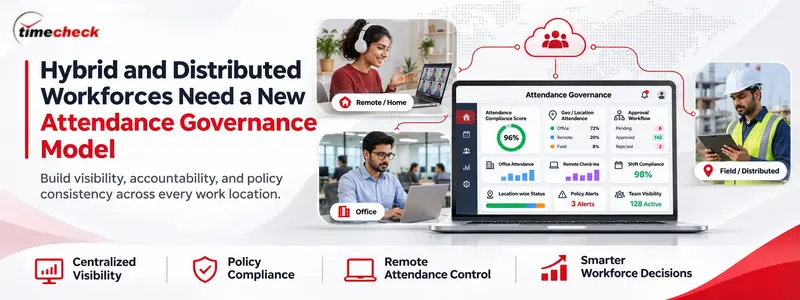
TimeCheck Software is presenting an editorial framework for managing attendance across hybrid, remote, field-based, and multi-location workforces. The analysis argues that enterprises need consistent attendance governance built around clear policies, appropriate data capture, transparent approvals, and secure access—not simply more methods of tracking employee presence.
The challenge has changed. An office employee may record attendance through a biometric device. A field technician may check in from a client location using a mobile application. A remote employee may submit an approved timesheet, while a hybrid employee may alternate between office and home-based work.
Each arrangement can generate a valid attendance record. The question for enterprise leaders is whether those records are being interpreted under clear, consistent, and fair rules.
About the Announcement
TimeCheck’s editorial perspective focuses on a distinction that becomes important as enterprises adopt more flexible operating models: consistent attendance governance does not require every employee to use the same attendance method.
Traditional attendance systems were designed primarily around physical workplaces. Employees arrived at a defined location, recorded their entry and exit, and followed an assigned schedule.
That model remains relevant for factories, hospitals, offices, and other environments where physical presence is essential.
It is less complete when an organization also manages remote employees, customer-site personnel, field service teams, and approved hybrid arrangements.
In those environments, attendance information may come from biometric devices, mobile applications, web-based records, GPS-enabled check-ins, timesheets, and manager-approved on-duty requests.
The technical ability to collect these records is only one part of the problem.
Organizations also need to determine which attendance rules apply, how exceptions are resolved, who can access the information, and what happens when an employee disputes a record.
The proposed approach treats attendance governance as a shared management responsibility involving HR, Operations, IT, and authorized supervisors.
The objective is not to make every work arrangement identical. It is to establish a dependable standard for how attendance information is captured, reviewed, protected, and used.
Why This Matters
Attendance is often treated as an administrative record.
In distributed enterprises, it also influences workforce availability, payroll preparation, client-site accountability, operational planning, and employee trust.
Problems arise when attendance rules are built around one working arrangement but applied to another.
Consider an employee approved to work remotely for three days.
If the attendance system expects an office biometric punch on all five working days, the employee may appear absent despite following an approved schedule.
A field employee may face a similar problem when working from a client site without access to the organization’s usual attendance device.
A hybrid employee may submit an attendance record through one method while the system expects another.
The resulting exception does not necessarily indicate poor attendance. It may indicate that the attendance policy has not kept pace with the actual work arrangement.
For HR, these mismatches create correction requests and employee disputes.
For Operations, they can affect location-wise workforce visibility and staffing decisions.
For IT, they create additional requirements around integrations, access, device reliability, and data security.
For employees, inconsistent rules can raise questions about fairness.
The governance challenge is therefore broader than recording when someone starts and finishes work.
It is ensuring that attendance records accurately reflect the working arrangement an organization has authorized.
Key Highlights
- Traditional attendance models may be insufficient for enterprises managing office, remote, hybrid, and field employees.
- Consistent governance should allow different attendance methods where operational requirements justify them.
- Mobile and geo attendance can support field workforce visibility, but location collection should have a defined business purpose.
- Approved remote and hybrid arrangements must be reflected correctly in attendance policies and workflows.
- Attendance exceptions should be reviewed in context rather than automatically treated as employee non-compliance.
- HR and IT need shared responsibilities for policy configuration, system access, data protection, and process reliability.
- Employees should understand what information is collected, how it is used, and how incorrect records can be challenged.
- Enterprises can assess governance quality by comparing attendance exceptions, approval delays, and correction patterns across workforce categories.
Why Traditional Attendance Models Fall Short
Traditional attendance management works best when employees operate under predictable conditions.
A fixed workplace, an established shift, and a common attendance device make it easier to apply one set of rules.
Distributed organizations rarely have that level of uniformity.
A manufacturing enterprise may manage office employees alongside plant workers and maintenance teams visiting multiple facilities.
A logistics organization may have warehouse employees, drivers, branch personnel, and supervisors working across different sites.
A facility management company may deploy workers to hospitals, banks, commercial buildings, and customer premises.
An IT services business may have employees working from offices, homes, and client locations under different approved arrangements.
Applying one attendance-capture method across these groups can create unnecessary exceptions.
Yet allowing every department to establish its own rules without central oversight can create another problem: inconsistent attendance interpretation.
An enterprise needs flexibility in how attendance is recorded and clarity about how the resulting information is governed.
This requires a distinction between attendance capture, attendance validation, and attendance governance.
Attendance capture establishes that a record has been submitted.
Attendance validation checks whether the record is consistent with the employee’s approved work arrangement and relevant rules.
Attendance governance determines who establishes those rules, who can review or change a record, how information is protected, and how disputes are resolved.
Organizations need all three.
The Five-Part Distributed Attendance Governance Model
A practical governance model can be organized around five controls.
| Governance Area | Primary Question | Recommended Management Practice |
|---|---|---|
| Policy clarity | What attendance rules apply to each work arrangement? | Define eligibility, schedules, approved work modes, and exception procedures |
| Appropriate data capture | What information is necessary to verify attendance? | Select suitable biometric, web, mobile, geo, or timesheet methods |
| Privacy and access control | Who can see attendance information, and for what purpose? | Set access permissions, collection limits, retention rules, and security controls |
| Transparent approvals and corrections | How are attendance discrepancies reviewed? | Establish documented approvals, correction histories, and employee review procedures |
| Governance measurement | Are policies operating consistently across teams? | Monitor exception rates, approval delays, corrections, and recurring policy mismatches |
The framework is a recommended management approach, not a claim that every organization must use the same technical configuration.
1. Establish Clear Policies for Different Work Arrangements
An enterprise-wide attendance policy should begin by defining the arrangements under which employees are authorized to work.
Those arrangements may include regular office attendance, rotating shifts, remote work, hybrid schedules, customer-site assignments, and field duties.
Each arrangement should specify the expected attendance method, applicable working-hour rules, approval requirements, and correction procedures.
The policy should also address temporary changes.
An employee assigned to an office may occasionally need to work from a client location. A hybrid employee may have an approved change in office days. A field worker may be redirected to another site.
If these changes are authorized but not reflected in attendance records, the organization may create exceptions that have little to do with actual attendance performance.
A good policy should make those situations manageable rather than treating them as unusual failures.
2. Match Attendance Capture to the Work Environment
No single method is appropriate for every workforce category.
Biometric devices may work well at fixed locations where employees regularly enter through designated access points.
Web-based attendance or approved timesheets may be appropriate for certain remote arrangements.
Mobile check-ins can support employees working away from their usual office.
GPS-enabled attendance may help verify a check-in associated with a particular worksite when that verification is necessary and appropriately authorized.
The important question is not which method collects the most information.
It is which method collects sufficient, reliable information for the stated attendance purpose.
TimeCheck’s Work from Home Attendance Solutions documentation describes configurable WFH policies, employee requests, approvals, and timesheet-based records. Its Geo Attendance Software documentation describes mobile clock-in and clock-out records with timestamps and GPS coordinates for field employees.
These capabilities illustrate different ways an enterprise may capture attendance.
The organization’s governance policy must determine when each method is appropriate.
3. Protect Attendance Data and Employee Privacy
Attendance systems can process information that employees reasonably expect their organizations to handle carefully.
This may include working hours, employee identifiers, workplace locations, attendance exceptions, and, where enabled, location coordinates or biometric-related information.
The availability of more detailed data does not automatically justify collecting or retaining all of it.
For example, location verification at an authorized field-site check-in serves a different purpose from continuous monitoring of an employee’s movements.
Organizations should distinguish between those activities before configuring attendance systems.
A useful governance review should establish:
- why a particular attendance data element is needed;
- which employees or work arrangements require it;
- when collection begins and ends;
- which authorized roles may access it;
- how long it should be retained;
- how employees are informed about its use; and
- how inaccurate information can be corrected.
The same principles apply when employees use personal devices for work-related attendance.
Enterprises should also review their obligations under the privacy, employment, and data-protection rules applicable to each country in which they operate.
Technology can support these controls, but the organization remains responsible for defining appropriate policies.
4. Make Attendance Corrections Transparent
Attendance exceptions are not always evidence of a workforce problem.
A missed punch may result from a device issue. A location mismatch may require verification. An approved remote-work day may not have been reflected in the schedule. A mobile attendance record may be delayed because of connectivity problems.
Treating every exception as identical can increase correction work and reduce employee confidence.
A better approach is to establish a documented route for review.
Employees should know how to request a correction.
Managers should know what evidence is required to approve one.
HR should be able to distinguish approved changes from unresolved exceptions.
Authorized users should be able to determine what was changed, why it was changed, and who approved it.
TimeCheck’s Discrepancy Management documentation describes manual-entry requests, supervisor approval or rejection, and the review of non-processed attendance records.
The wider governance requirement is that corrections are handled consistently, regardless of whether the employee works in an office, at home, or at a client location.
5. Measure Governance Quality, Not Just Attendance Volume
Enterprises commonly measure attendance through present and absent counts, late arrivals, and working hours.
Those measures remain useful, but they do not fully indicate whether a distributed attendance policy is functioning correctly.
Governance performance requires additional questions.
Are some workforce categories generating unusually high numbers of corrections?
Do field employees wait longer for attendance approvals?
Are remote-work exceptions caused by inconsistent policy configuration?
Are hybrid employees being incorrectly marked absent on approved remote days?
Do particular branches require repeated manual intervention?
These questions help HR and Operations distinguish employee attendance patterns from weaknesses in the attendance process.
The objective is not to label one work arrangement as more reliable than another.
It is to identify where governance controls need improvement.
Attendance Visibility Should Not Become Continuous Surveillance
One of the most important decisions in distributed attendance governance concerns the boundary between legitimate verification and excessive monitoring.
Enterprises need to know whether employees are available for assigned work, whether attendance records are accurate, and whether approved schedules are being followed.
That does not automatically mean they need to monitor every aspect of an employee’s working day.
A mobile location check-in may establish that an employee submitted attendance from a particular location at a particular time.
It does not, by itself, establish the quality of work performed, explain the employee’s circumstances, or measure productivity.
These are different questions and may require different forms of evidence.
The UK’s Information Commissioner’s Office guidance on monitoring workers emphasizes transparency, a defined purpose, appropriate limits on data collection, and the selection of less intrusive methods where possible. The guidance concerns UK data-protection requirements and is not a substitute for legal assessment in India or other markets.
The broader management lesson is relevant across distributed enterprises.
Workforce visibility should answer a legitimate operational question. It should not become an unrestricted reason to collect more employee data.
How HR and IT Should Share Accountability
Attendance governance is often assigned to HR because attendance policies affect employees.
In modern distributed enterprises, that responsibility cannot be managed effectively without IT and Operations.
HR defines workforce policies, approved work arrangements, attendance exceptions, and employee correction procedures.
IT supports the systems that capture and process the information. It also helps ensure reliable integrations, appropriate user permissions, secure access, and dependable records across devices and locations.
Operations validates actual work arrangements, shift changes, site assignments, and relevant attendance exceptions.
Managers are responsible for reviewing the requests and records assigned to them.
Payroll and Finance need dependable attendance inputs when working hours, leave, and overtime affect pay.
These responsibilities should be connected rather than treated as separate administrative tasks.
For example, if a field employee’s mobile check-in fails because of connectivity, IT may investigate the technical issue, Operations may confirm the work assignment, and HR may oversee the approved correction procedure.
No single team necessarily holds all the information required to resolve the exception.
A governance model should establish how those teams work together without creating unnecessary approval delays.
Comparing Attendance Exceptions Across Work Arrangements
Enterprises can evaluate attendance governance by comparing exception patterns across office-based, field, remote, and hybrid workforces.
The analysis should focus on comparable processes and clearly defined records.
Work Arrangement Attendance Exception Matrix
| Workforce Category | Attendance Information to Review | Relevant Exceptions | Governance Question |
|---|---|---|---|
| Office-based employees | Biometric, device, or approved web attendance | Missed punches, late entries, early exits, device errors | Are office attendance rules applied consistently? |
| Field employees | Authorized mobile, geo, or on-duty records | Location mismatches, delayed submissions, pending site approvals | Is verification appropriate to the work assignment? |
| Remote employees | Approved remote attendance and timesheets | Missing submissions, delayed approvals, correction requests | Are approved remote arrangements reflected accurately? |
| Hybrid employees | Records from approved office and remote days | Work-mode mismatches, duplicate entries, inconsistent approvals | Do attendance rules reflect the employee’s approved schedule? |
This framework is intended for enterprise analysis. It does not represent measured TimeCheck customer data.
Recommended Metrics
A useful assessment could cover eight to twelve weeks and measure:
- attendance exception rate;
- manual correction frequency;
- average approval turnaround time;
- unresolved exceptions at the reporting cutoff;
- work-mode classification errors;
- attendance-related employee disputes; and
- recurring technical or policy-related exceptions.
Absolute exception counts should be interpreted carefully.
An organization with 1,000 office employees and 100 field employees may naturally have more office attendance records and more total exceptions.
A more useful comparison is the number of exceptions per 1,000 required attendance records, supported by separate approval and correction measures.
Hybrid work also requires careful classification. An approved office day and an approved remote day may follow different rules. Each attendance record should be classified against the work mode authorized for that day to avoid double-counting or misleading comparisons.
The definition of an exception should remain consistent across reporting periods.
For example, an unresolved missing record should not be counted separately as a missing punch, a manual correction, and a payroll dispute without making the relationship between those events clear.
The goal is to identify why an exception occurred and whether the process handled it appropriately.
Turning the Findings into Action
Suppose a company finds that field employees have longer approval times than office employees.
The reason may not be poorer attendance compliance.
Field approvals may pass through several client-site supervisors, while office records are validated centrally.
The organization could then review its approval responsibilities, reporting process, and escalation rules.
Similarly, if hybrid employees generate repeated attendance corrections on approved remote days, the issue may lie in work-mode configuration rather than employee behavior.
These are illustrative scenarios, not reported customer outcomes.
The value of the comparison lies in identifying which attendance process creates unnecessary work and how it can be corrected.
What Enterprise Experience Shows
TimeCheck’s published implementation material offers examples of why attendance capture methods may need to vary with operating conditions.
In its Remote Location Attendance Monitoring Solution, the company describes a service-sector organization deploying employees across hotels, banks, malls, and hospitals.
Some locations had too few employees or insufficient connectivity to justify a fixed attendance device.
According to the company-published case study, TimeCheck supported the arrangement using portable biometric devices with temporary local storage and subsequent synchronization.
The example illustrates a practical point: a reliable attendance process must account for the conditions under which employees actually work.
A separate distributed contract workforce case study describes an anonymized enterprise operating across multiple client locations.
The company reports that centralized attendance records, controlled approval workflows, and audit-ready information were associated with fewer attendance-linked payroll disputes and less manual reconciliation.
Those are outcomes reported by TimeCheck for a particular implementation, not independent benchmarks or evidence that one attendance method is appropriate for every organization.
Together, the cases reinforce the need to connect attendance technology with operational conditions, approval responsibilities, and reliable records.
Industry Context
Hybrid and flexible working arrangements continue to influence how employers manage workforce policies.
The CIPD’s Flexible and Hybrid Working Practices in 2025 report found that 91% of surveyed UK employers offered some form of flexible working arrangement. The research also described hybrid working provisions as common among UK employers.
These findings are specific to the UK and should not be used as estimates for India, the Middle East, or global enterprises.
They do, however, illustrate the continuing management challenge: employers must apply workforce policies across different work arrangements while balancing operational needs and employee expectations.
For India- and Middle East-focused enterprises, the issue is also shaped by multi-branch operations, contract workers, customer-site deployments, rotating shifts, and differing local requirements.
TimeCheck’s State of Attendance Automation in Indian & Middle East Enterprises identifies distributed workforce visibility, disconnected attendance records, manual corrections, and inconsistent reporting as recurring concerns in its implementation-based observations.
The next stage of attendance management therefore requires more than consolidating records.
Organizations need to examine whether the policies governing those records remain appropriate for the work arrangements they are intended to support.
Employee Trust Depends on Clear Rules
Employee trust is often discussed as a cultural issue.
Attendance governance gives it an operational dimension.
Employees need to understand what attendance information is expected, how it will be recorded, who will review it, and what happens if the information is incorrect.
A policy becomes harder to trust when employees cannot explain why one attendance method applies to them or why a correction has been rejected.
Transparency does not mean that every employee must have the same schedule or working arrangement.
A hospital nurse, a field technician, and a remote software engineer may have different attendance requirements for legitimate reasons.
Fairness depends on whether those differences are based on clear operational needs and whether the applicable rules are communicated and followed consistently.
The stronger governance test is not whether every employee produces an identical attendance record.
It is whether every employee can understand the rules that apply to their work.
Expert Perspective
The future of distributed workforce attendance management should not be measured solely by how much attendance information an enterprise can collect.
It should also be measured by whether that information is accurate, appropriate, secure, and consistently interpreted.
A company may have reliable biometric attendance at its head office but weak approval controls for field staff.
Another may support remote work yet continue applying attendance rules designed for office-only schedules.
In both situations, the challenge is not necessarily the absence of technology.
It is the gap between attendance policy and workforce operations.
The more useful management model brings HR and IT together to define how attendance information should be collected, validated, accessed, and corrected across different working arrangements.
Operations contributes the context needed to distinguish legitimate exceptions from actual policy concerns.
Employees receive clearer expectations and a more transparent correction process.
The objective is one standard of accountability, supported by attendance methods appropriate to each working environment.
About TimeCheck Software
TimeCheck Software provides enterprise time and attendance management solutions for organizations operating across offices, branches, factories, customer sites, and distributed workforce locations.
The platform supports attendance capture, leave and permission management, shift and roster planning, overtime tracking, biometric device integration, mobile and geo attendance, work-from-home approvals, discrepancy management, dashboards, reports, and payroll-ready workforce information.
Its applications serve organizations in manufacturing, healthcare, IT/ITES, logistics, education, facility management, construction, and other sectors with complex workforce requirements.
TimeCheck’s corporate office is located in Coimbatore, India. The company reports more than 300 customers and operations across over 20 industry verticals on its website. It also maintains a channel-partner and system-integrator program.
TimeCheck’s published FAQ explains that mobile and GPS-based attendance depend on customer configuration, attendance policies, user access, and implementation scope. Enterprise customers generally control their attendance rules, employee data access, and internal approval policies.
These capabilities provide a technical foundation for distributed attendance management. Enterprises remain responsible for selecting the policies, safeguards, and governance procedures appropriate to their operations.
Explore the TimeCheck Product Demo to understand attendance capture, remote-work approvals, geo attendance, exception management, and multi-location reporting workflows.
FAQs
Companies can compare attendance exception rates, manual corrections, approval delays, work-mode mismatches, and unresolved records across office, field, remote, and hybrid groups. They should use comparable definitions and normalize counts by attendance-record volume. The findings can help identify policy configuration problems, approval bottlenecks, and recurring operational issues without assuming one group is less compliant.
HR should define attendance policies, approved work arrangements, exception rules, and correction procedures. IT should support secure systems, reliable integrations, user permissions, and data availability. Operations should validate work assignments and relevant exceptions. Coordination between these teams helps ensure that attendance records are both operationally useful and appropriately governed.
Enterprises should define why location information is necessary, when it should be collected, who can access it, and how long it will be retained. Location verification for an authorized worksite check-in is different from continuous movement tracking. Collection practices should be transparent, proportionate, secure, and aligned with applicable legal requirements.
Traditional attendance systems often assume employees work at a fixed location under a defined schedule. Hybrid employees may alternate between office and approved remote days, making a single attendance method insufficient. Without suitable work-mode rules, organizations can generate incorrect absences, duplicate records, unnecessary corrections, and inconsistent attendance interpretations.
Distributed workforce attendance governance is the set of policies, responsibilities, and controls used to manage attendance across office, remote, hybrid, field, and branch-based employees. It covers how attendance is recorded, validated, corrected, accessed, and reviewed. The objective is consistent accountability while allowing appropriate differences in attendance methods and working arrangements.
Content ownership: TimeCheck Software Editorial Team
Subject-matter review: TimeCheck Product Management, HR Tech & Implementation Team
Last reviewed: October 2026
This article is reviewed to ensure accuracy across TimeCheck product capabilities, workforce planning concepts, attendance management workflows, shift operations, and enterprise implementation practices.
Learn more about TimeCheck’s company background and experience on the
About Us
page.

