



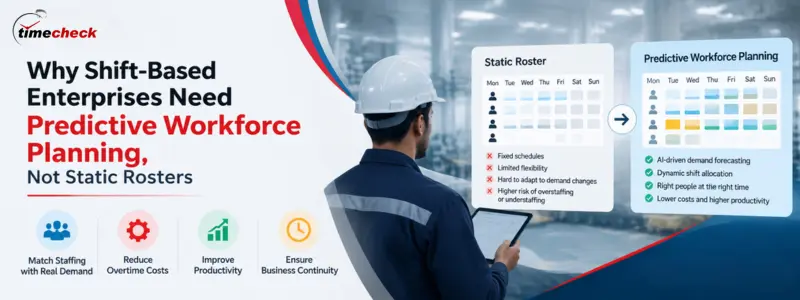
Shift-based enterprises often face a gap between planned workforce availability and actual employee availability. A roster can show that employees have been assigned to shifts, but it does not always show whether enough people will actually be available when operations begin. For organizations managing factories, hospitals, logistics networks, utilities, infrastructure sites, and other round-the-clock environments, relying only on static rosters can create unexpected workforce coverage risks.
Shift coverage forecasting helps enterprises move beyond schedule creation by analysing attendance patterns, absenteeism trends, overtime dependency, shift adherence, and planned versus actual staffing levels. Instead of only asking who is scheduled, organizations can understand where workforce availability may create operational pressure before the next shift begins.
TimeCheck Software helps shift-based enterprises improve workforce visibility by connecting attendance data, shift information, overtime records, and workforce availability insights to support better operational workforce planning.
About the Announcement
TimeCheck Software has outlined an executive perspective on why shift-based enterprises should move beyond static roster planning and start examining workforce coverage risk before a shift begins.
The approach connects planned staffing with actual attendance, absenteeism, overtime pressure, and recurring department-level shortages to give HR and Operations an earlier view of potential disruption.
For organizations operating factories, hospitals, logistics networks, utilities, infrastructure sites, and other round-the-clock environments, the distinction matters.
A roster can confirm that enough employees have been scheduled. It cannot, by itself, confirm that enough employees will actually be available when operations begin.
Why Shift-Based Enterprises Need Predictive Workforce Planning
TimeCheck’s perspective focuses on a simple operational gap: planned staffing and actual workforce availability are not the same thing.
Traditional roster planning is largely schedule-based. Managers determine how many employees are required, assign people to shifts, publish the roster, and then respond to changes as they occur.
This approach works reasonably well when workforce availability and business demand are stable.
It becomes less reliable when operations face:
- Frequent absenteeism
- Rotating shifts
- Unexpected leave
- Overtime accumulation
- Multi-location staffing requirements
- Changing production requirements
- Last-minute attendance exceptions
TimeCheck’s product-market fit research identifies manual shift allocation as a source of resource mismatch and inefficiency for distributed and shift-based enterprises. The same research highlights difficulty tracking attendance, overtime, and shift adherence, as well as inefficient planning caused by delayed or inaccessible workforce data.
The issue is therefore not simply whether an enterprise has a roster.
The more useful question is whether the organization can identify where that roster is repeatedly failing to translate into actual workforce coverage.
Why This Matters
In a shift-based operation, a staffing shortage rarely remains only an HR issue.
A missing production crew can affect output. Insufficient healthcare staffing can place pressure on available teams. A logistics staffing gap can delay loading, dispatch, or warehouse activity.
Repeated shortages may also increase overtime requirements and force managers into last-minute workforce reallocation.
Static rosters provide a plan.
Operational continuity depends on what happens when that plan meets actual attendance.
This creates an important distinction between roster accuracy and coverage reliability.
A roster may be administratively correct while still producing recurring coverage gaps.
If 50 employees are scheduled but historical patterns show that only 44 to 46 are typically available for that shift, the operational problem is not necessarily roster creation.
It is the gap between planned and actual workforce availability.
Predictive workforce planning begins by making that gap visible.
It does not require an enterprise to assume that every absence can be predicted.
Instead, HR and Operations can identify recurring patterns that deserve attention:
- Departments with persistent shortages
- Shifts with above-normal absenteeism
- Teams dependent on overtime
- Locations that repeatedly require last-minute replacements
That changes workforce planning from:
Who is scheduled?
to:
Where are we most exposed if actual attendance differs from the plan?
Key Highlights
- Static rosters show planned workforce allocation but do not necessarily show likely workforce availability.
- Historical attendance can help identify shifts, departments, and locations with recurring coverage gaps.
- Absenteeism trends, overtime build-up, shift adherence, and planned-versus-actual headcount are practical indicators of staffing pressure.
- Repeated overtime can be a capacity signal, not merely a payroll metric.
- Comparing planned staffing with actual attendance helps separate isolated absence events from persistent workforce patterns.
- HR, Operations, and Finance need different views of the same staffing data.
- Predictive workforce planning should support managerial decisions rather than automatically replace operational judgment.
- Clean attendance and shift data must come before reliable workforce forecasting.
Why Manual Shift Allocation Reaches Its Limit
Manual scheduling is not inherently ineffective.
In smaller or highly predictable environments, an experienced supervisor may understand workforce requirements well enough to create reliable schedules.
The difficulty appears as variability increases.
A manufacturing plant may have multiple production lines, skill requirements, weekly offs, rotating shifts, overtime limits, and unplanned absences.
A hospital may have multiple departments operating continuously with different workforce requirements.
A logistics operation may need staffing across warehouses, loading areas, transport operations, branches, and peak dispatch periods.
At that point, a spreadsheet or static roster can still document the schedule, but it becomes harder to use it to identify recurring workforce risk.
McKinsey has described workforce scheduling as a complex optimization problem because organizations must balance changing demand, employee availability, different workforce types, skills, shifts, and unexpected changes.
Its workforce scheduling research also emphasizes the value of regularly refreshed data and short-range forecasts for identifying mismatches between available crews and expected work before they create last-minute operational problems.
The implication for shift-based enterprises is practical: better planning requires more than digitizing a roster.
It requires connecting the roster to what actually happened.
Attendance History Is a Planning Dataset
Attendance history is usually treated as a record of past workforce activity.
For predictive workforce planning, it can also serve as a planning dataset.
Consider a department that appears adequately staffed every Monday morning according to its roster.
If actual attendance shows that the same shift has fallen below planned headcount in six of the previous eight weeks, that pattern deserves attention.
The organization can then investigate.
Possible causes might include:
- Recurring absenteeism
- Weekly-off configuration
- Transport constraints
- Leave concentration
- Skill-specific shortages
- Shift preference
- Staffing assumptions
- Overtime fatigue
- Approval delays
- Production requirements that no longer match the original workforce plan
Attendance data does not automatically establish the cause.
It identifies where management should investigate.
That distinction matters.
Predictive workforce planning should not become an exercise in making unsupported assumptions about individual employees.
Its value comes from identifying operational patterns at an appropriate level—such as shift, department, location, workforce category, or time period—and using those patterns to support planning.
Four Indicators of Shift Coverage Risk
1. Planned vs. Actual Staffing
The first measure is straightforward:
How many employees were planned for the shift, and how many were actually available?
Tracking the difference over time creates a coverage variance.
A single shortfall may be incidental.
A recurring shortfall on the same shift or within the same department may indicate a structural planning issue.
2. Absenteeism Trends
Absenteeism becomes more useful for workforce planning when it is analyzed as a pattern rather than a monthly total.
HR and Operations can examine whether absence frequency is concentrated around particular:
- Shifts
- Departments
- Days
- Locations
- Workforce categories
- Operating periods
The purpose is not to assume why employees are absent.
It is to understand whether workforce availability has become less predictable in parts of the operation.
3. Overtime Build-Up
Overtime can help an enterprise maintain continuity when staffing falls below requirements.
Repeated overtime, however, can also indicate that scheduled capacity is not matching operational requirements.
If one department regularly depends on overtime to maintain planned coverage, leaders should ask whether the issue is:
- Absenteeism
- Demand
- Workforce allocation
- Skill availability
- Roster design
- Baseline staffing
This makes overtime both a cost measure and a workforce capacity indicator.
4. Department-Level Staffing Gaps
Enterprise-wide averages can hide operational problems.
An organization may appear adequately staffed overall while one production department, hospital unit, warehouse function, or location repeatedly operates below its planned requirement.
Coverage analysis therefore needs to work at a level where managers can act.
That usually means comparing workforce availability by:
- Department
- Location
- Shift
- Operating period
rather than relying only on company-wide headcount.
The Planned-vs.-Actual Workforce Coverage Framework
A useful starting point is a Planned-vs.-Actual Workforce Coverage Matrix.
This is a measurement framework, not customer performance data.
| Metric | What to Compare | What It Can Reveal |
|---|---|---|
| Planned headcount | Employees scheduled for a department or shift | Expected workforce capacity |
| Actual attendance | Employees actually available | Real workforce capacity |
| Coverage variance | Planned headcount minus actual attendance | Size of staffing shortfall or surplus |
| Absence frequency | Absence pattern by shift, department, or location | Recurring availability pressure |
| Shift adherence | Scheduled shift compared with actual attendance | Reliability of roster execution |
| Overtime hours | OT required by department or shift | Possible capacity or scheduling pressure |
| Replacement frequency | Number of last-minute staffing replacements | Roster instability |
| Coverage-gap frequency | Number of shifts below planned staffing | Recurrence of workforce shortages |
Consecutive gap periodsRepeated shortages across multiple periodsPotential structural staffing issueAttendance exceptionsMissing punches, mismatches, late arrivals, early exitsData quality or execution issuesThe important metric is not simply whether a staffing gap occurred.
It is whether the same type of gap keeps returning.
From Coverage Variance to Management Action
The purpose of a coverage matrix is not to generate another dashboard.
It is to improve decisions.
Suppose an enterprise discovers that a particular night shift falls below planned staffing twice as often as other shifts.
HR may examine absenteeism and leave patterns.
Operations may review required headcount and production demand.
Supervisors may review shift adherence and replacement processes.
Finance may examine overtime generated by the shortage.
Management may determine whether the issue requires:
- Different staffing levels
- Scheduling rules
- Cross-training
- Workforce redeployment
- Another operational response
The same data therefore serves different decisions.
That is why predictive workforce planning should be cross-functional rather than owned by HR alone.
Industry Context
The shift from static scheduling toward dynamic workforce planning is already visible in broader workforce-management research.
McKinsey’s work on frontline manufacturing argues for dynamic workforce planning that connects demand and supply forecasting with skill mapping and flexible shift structures.
Its research also notes that absenteeism and workforce instability can increase overtime and other labor costs.
Deloitte’s 2025 analysis of autonomous workforce planning similarly describes operational planning models that use historical information and multiple data sources to support dynamic scheduling and respond to changes in employee availability or demand.
The direction is important, but enterprises should avoid jumping directly from spreadsheets to complex predictive models.
Forecasting is only as useful as the operational data underneath it.
If attendance records are incomplete, shifts are mapped incorrectly, leave information is delayed, overtime approvals are inconsistent, or exceptions remain unresolved, the resulting workforce forecast may simply automate poor assumptions.
For many enterprises, the first step toward predictive planning is therefore not artificial intelligence.
It is establishing reliable attendance, shift, leave, overtime, and workforce-availability data.
The Link Between Roster Accuracy and Operational Continuity
Roster accuracy is sometimes treated as an HR administration measure.
In shift-intensive operations, it is also an operational control.
A roster influences:
- Who is expected to be available
- Where employees are assigned
- When work can begin
- Whether overtime may be required
- Whether sufficient workforce capacity exists to maintain operations
TimeCheck’s current product structure reflects this connection.
Its Shift Management functionality covers employee shift allocation, rotating and 24-hour shifts, shift adherence, overtime monitoring, and multi-location workforce scheduling.
Its wider platform connects attendance, leave, overtime, exceptions, reports, and payroll-ready workforce data.
TimeCheck’s published attendance automation report also identifies different shift-related pressures by industry:
- Shift mismatch and overtime in manufacturing
- Rotational staffing and availability in healthcare
- Distributed workforce visibility in logistics
The business case for better roster planning is therefore broader than saving HR time.
The objective is to reduce the distance between the workforce an operation expects to have and the workforce it actually has available.
What Predictive Workforce Planning Should—and Should Not—Do
Predictive planning should not be presented as certainty.
Absence cannot always be forecast.
Demand can change unexpectedly.
Employees are not fixed variables, and operational managers will continue to make judgment calls.
A better objective is risk visibility.
Instead of claiming that a system can know exactly who will be available next Tuesday, an enterprise can ask:
- Which departments repeatedly operate below planned staffing?
- Which shifts have the highest coverage variance?
- Where is overtime repeatedly being used to compensate for shortages?
- Which locations experience the most last-minute replacements?
- Which periods historically create the greatest staffing pressure?
- Where does actual attendance consistently differ from roster assumptions?
Those questions are more useful because they turn historical workforce data into evidence for operational planning without pretending that forecasting eliminates uncertainty.
Expert Perspective
The shift from static rosters to predictive workforce planning reflects a broader change in how enterprises approach shift operations.
Workforce planning should be measured by more than how efficiently a roster is created.
A stronger measure is how reliably planned staffing translates into actual operational coverage.
Attendance history provides a factual record of the difference between workforce plans and workforce reality.
By comparing planned staffing with actual attendance, absenteeism, overtime, and recurring coverage gaps, HR and Operations can identify areas of workforce pressure earlier and make better-informed staffing decisions.
This approach does not assume that every absence or staffing change can be predicted.
Instead, it uses recurring workforce patterns to improve visibility, support planning, and help managers respond to potential coverage risks before they affect operations.
About TimeCheck Software
TimeCheck Software provides enterprise time and attendance and workforce management capabilities for organizations managing complex attendance and shift operations.
Its current product structure includes:
- Attendance management
- Leave management
- Shift and roster planning
- Overtime tracking
- Biometric device integretion
- Geo and mobile attendance
- Workforce dashboards
- Reports
- Multi-location attendance
- Payroll-ready workforce data
TimeCheck’s target market includes medium and large organizations with distributed or shift-based workforces, including manufacturing, healthcare, logistics, IT/ITES, education, and other workforce-intensive sectors.
The company lists offices in Coimbatore, Chennai, Dubai, New York, London, Waterloo, Singapore, Hong Kong, and Sydney on its Global Locations page.
TimeCheck’s Recognition page currently takes a verification-first approach: it publishes customer feedback while stating that awards, certifications, partner validations, ratings, and media recognition are added only when supporting evidence is available.
FAQs
Attendance history can show whether specific shifts, departments, days, or locations repeatedly operate below planned staffing. HR and Operations can use these patterns to investigate absenteeism, overtime pressure, shift adherence, workforce allocation, or staffing assumptions and make more informed decisions about future workforce coverage.
Static rosters show who has been scheduled, but actual workforce availability can change because of absence, leave, shift deviations, demand changes, or other operational factors. Manufacturing plants, hospitals, logistics operations, and other 24/7 environments therefore benefit from comparing planned staffing with actual attendance and recurring coverage patterns.
Predictive workforce planning uses historical workforce data and operational patterns to identify future staffing risks. In shift-based enterprises, this can include planned versus actual attendance, absenteeism trends, overtime dependency, shift adherence, and recurring department-level shortages. The objective is to identify potential coverage pressure before it disrupts operations.
Content ownership: TimeCheck Software Editorial Team
Subject-matter review: TimeCheck Product Management, HR Tech & Implementation Team
Last reviewed: September 2026
This article is reviewed to ensure accuracy across TimeCheck product capabilities, workforce planning concepts, attendance management workflows, shift operations, and enterprise implementation practices.
Learn more about TimeCheck’s company background and experience on the
About Us
page.

